How much and when to brew
A larger batch yields more beer, but it occupies tanks for longer and may not find its buyer in time.
Economic strategy · browser prototype
A strategy game about growing your own brewery. The player plans batches, watches tank capacity and stock freshness, finds buyers and decides where to invest the earnings: equipment, research, new beer styles, staff or brands.
In developmentThe core loop already runs in a browser prototype; content, balance and artwork are being developed now. The interface is currently in Russian, and “A brewery management game” is a working title.
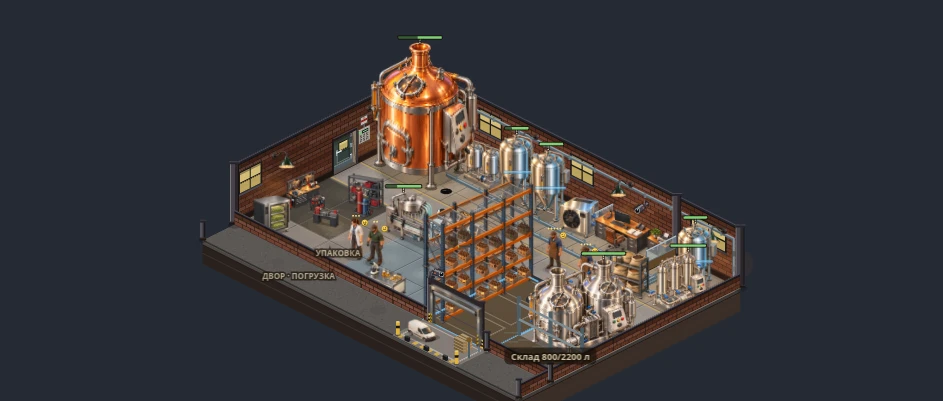
This is not an idle clicker where you simply wait and collect coins. Every batch goes through a production chain, resources are limited at each step, and how the player allocates them shapes what they can do next.
Style, volume and packaging — kegs, bottles or cans. Cost, expected revenue, margin and spoilage risk are shown before launch.
The kettle and the brewer are busy while brewing, so there is almost always less capacity than you would like.
The batch occupies a fermentation tank for several in-game days. The number of tanks limits how many batches run at once.
The packaging line fills the chosen containers. It can be sped up by buying equipment.
Finished beer keeps only for a limited time. Old stock loses freshness and has to be written off.
Buyers offer different prices and volumes. Delivery is by customer pickup or a carrier.
Revenue minus ingredients, energy and water, packaging, tax, wages and other costs.
Equipment, recipe research, new styles, staff and brands — and the next cycle plays differently.
↺ Back to planning
The diagram shows the steps one after another; in the game they overlap: while one batch ferments in a tank, the next one is already brewing and finished beer waits for a buyer in the warehouse.
The interest comes from clear trade-offs rather than the number of buttons. Every decision costs something — money, time, an occupied tank or a missed buyer.
A larger batch yields more beer, but it occupies tanks for longer and may not find its buyer in time.
Beer cannot be stockpiled forever: shelf life depends on packaging, and surplus goes to disposal. Warehouse security lowers the risk of partial theft of finished stock.
Buyers come and go. The batch card shows in advance who is ready to buy and whether you will make it in time.
Paying cash or taking credit, upgrades and maintenance — every investment competes with the others. Equipment wears and can break down.
People have skills and specific jobs. A technologist researching a recipe is not available for anything else at that time.
A new recipe costs money and the technologist’s time, and its value depends on the market. In the game, for example, porter is valued by restaurants and shops, while Double IPA pays off through special fresh-beer deliveries.
Brew another batch — or sell existing stock first and free up the tanks?
The prototype runs the whole loop — from batch planning to sales and growth — and remembers progress between sessions. The player’s main working tool is the new-batch card.
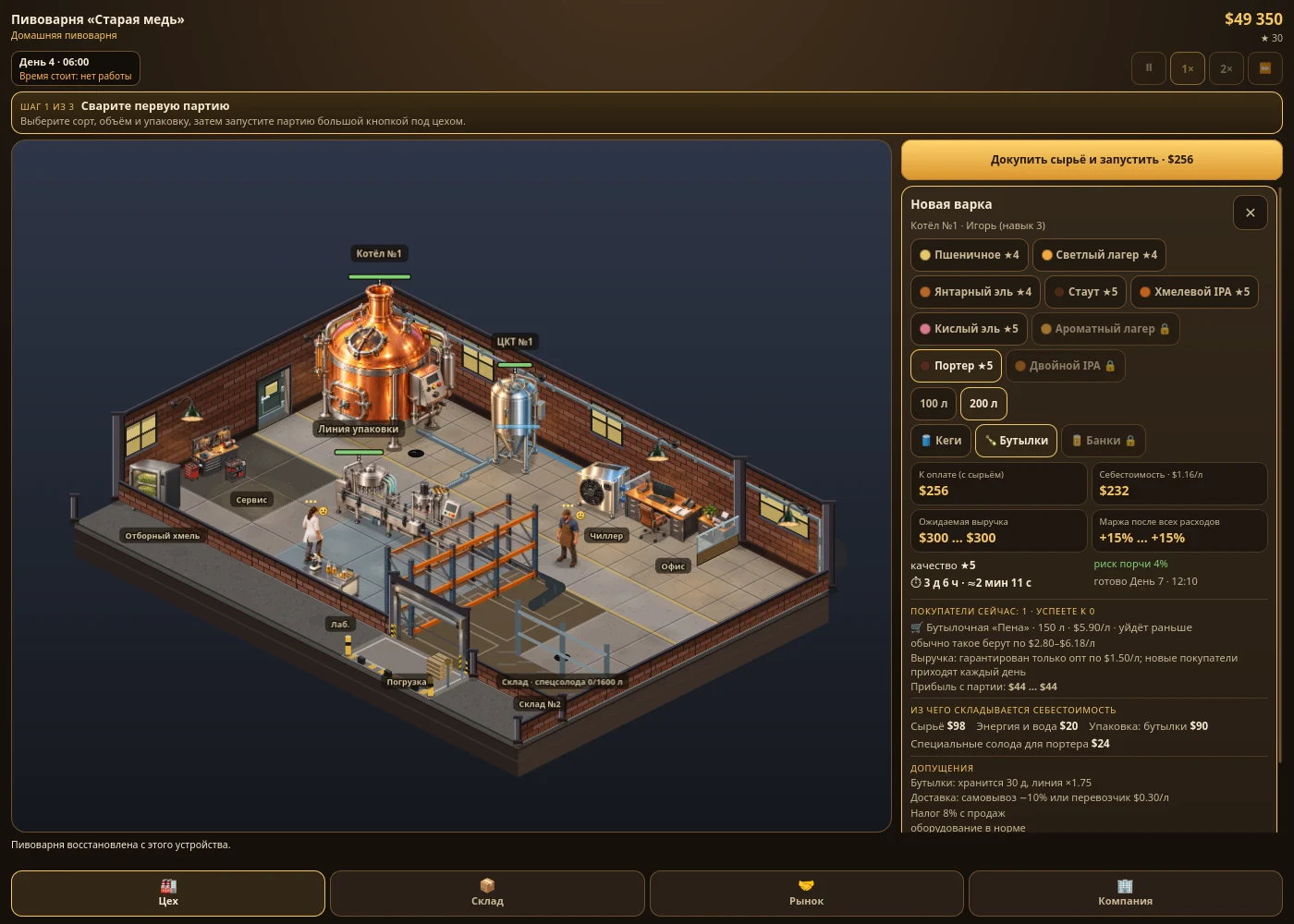
Before brewing, the player chooses a style, batch volume and packaging. The card immediately shows:
Locked items are styles and packaging still to be unlocked through research or purchase.
An isometric workshop with kettles, fermentation tanks, a filter, packaging line, ingredient storage, warehouse, lab, workshop bench and loading bay; equipment wears and needs maintenance.
Animated staff walk around the floor to their equipment and workstations.
A production chain: plan → brew → ferment → package → warehouse.
A warehouse with freshness: shelf life, write-offs and protection against partial theft.
A market: buyers, orders, delivery by pickup or carrier.
A “Company” section: finance, people, equipment, development and brands.
Research costs money and time: unlockable styles include porter, Double IPA, APA and German pilsner.
Saved progress: batches, money and research are restored after a page reload.
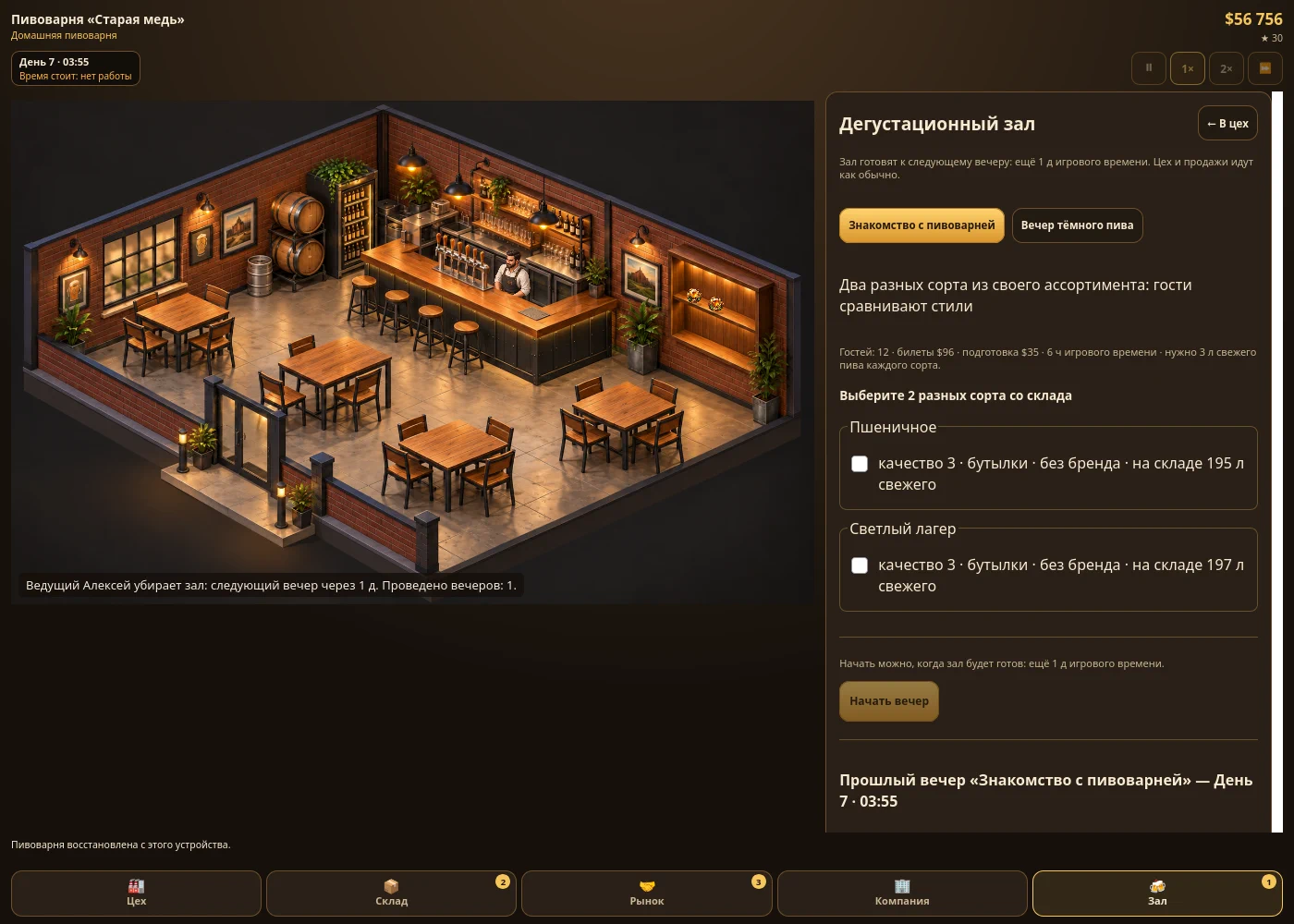
From the workshop the player can switch to a tasting hall. It is not a menu with a button but a live scene of its own, with a bar, tables, a host and guests — and a separate promotion tool.
The aim is a game that stays interesting rather than merely long: play time is not padded with waiting or repetitive grinding. New content is added when it gives the player a new choice.
The game is one of the applied projects of Anton Konnov’s laboratory. Its concept, architecture and development follow the author’s own design; AI tools are used for engineering and for processing the artwork.
The economy, production, warehouse, market and growth are designed as one connected system in which every step has a clear cost.
Work is split into small tasks with clear criteria. Modules, tests and fixes are written with AI tools — Codex, Claude and the laboratory’s local models.
Equipment and scene images were generated and hand-selected. Staff walking motion was transferred with neural tools on the lab’s own GPU server.
Automated tests of the economy and saves, followed by a review of the live scene in a browser on desktop and mobile screens.
Other games, applications and method write-ups produced in the same laboratory.
Get in touch
Write if you would like to discuss the project, a collaboration or a similar development.
Discuss the projectAll contacts